
Custom countertop strategies allow a tiny kitchen to seem more open and visibly large without significant changes. The area looks brighter and more continuous by opting for brighter tones, smooth edges, and long countertop lines. Adding reflective finishes or matching countertops with backsplashes can give a streamlined, consistent aspect that makes every inch count.
Custom Countertop Strategies 1: Opt for a Thin or Ultra-Slim Countertop Profile
Selecting a thin or ultra slim countertop profile is among the most efficient yet occasionally underutilised techniques to aesthetically expand a small kitchen. Giving the kitchen visual weight with thicker edges on standard countertops will help it appear more contained and enclosed.
An ultra-thin profile — commonly 12 mm to 20 mm on the other hand opens the space and gives it a sophisticated, spacious aspect. Less noticeable and lets the eye glide over the surfaces, this slick edge creates the appearance of more counter space and a more spacious plan. Thin counters look also really elegant, especially in modern or minimalist kitchen settings when clean lines and understated beauty are absolutely necessary.
Open shelves, handleless cabinets, and integrated appliances are ideal to highlight visual continuity. Materials such as quartz, porcelain slabs, and compact surfaces are very well-suited for slender profiles due of their strength and longevity even at small thicknesses. Beyond the aesthetic benefits, a very thin countertop can accentuate other architectural features like great backsplash or contemporary cabinets.
Cutting bulk transforms the countertop from the focal point to a peaceful backdrop, therefore fostering a more brilliant, lighter mood. Choosing a thin countertop edge is a wise, modern design choice that helps to maximise visual space without sacrificing quality or utility whether you’re reviving a tiny condo kitchen or rebuilding a little apartment pantry.
Custom Countertop Strategies 2: Favour Minimal Veining or Subtle Patterns
 Choosing countertops with little veining or subtle patterns is a potent but underused design approach for visually expanding a small kitchen. In small spaces, every surface has a great visual impact, so bold, high-contrast veining or heavy granularity countertops might overload the eye and make the area seem cluttered and visually chaotic.
Choosing materials with soft, subtle veining or consistent, low-contrast patterns lets the other aspects of the kitchen breathe by providing a calmer and more cohesive backdrop. This subtlety supports openness as the surface seems to be flowing and continuous rather than divided by strong pattern changes. Good choices that balance character with restraint include light quartz with subtle marble-like veining, smooth terrazzo with tiny flecks, or honed solid surfaces.
@ampquartzcabinets Yang planning nak buat outdoor kitchen boleh try pakai sintered stone ni! 😍 #AmpQuartz #outdoorkitchen #sinteredstone #countertop #fyp
The aim is to create depth and texture without needless visual clutter. Combining these subdued counters with pale cupboards and backsplash colours enhances the sense of space as the eye glides across one surface to the next. Moreover, subdued designs age more gracefully and are simpler to incorporate around as tastes change with time.
They enable decorative elements such warm wood tones, matte black hardware, or greenery to stand out without rivalry. Choosing for little veining allows you to shape the kitchen’s visual harmony, guaranteeing it seems bigger, lighter, and more artfully elegant. You’re not simply selecting a surface treatment.
Custom Countertop Strategies 3: Consider Waterfall Edges for Vertical Continuity
Incorporating waterfall edges into your countertop design can significantly expand a little kitchen’s appearance. The countertop material goes flawlessly down the sides of the cabinet or island to create a continuous vertical line that draws the eye downward and elongates the impression of space.
This design philosophy eliminates visual breaks, which frequently lead smaller kitchens to seem enclosed or disorderly. Letting the countertop flow over the edge gives the kitchen an elegant, more cohesive, and architecturally deliberate look, therefore enhancing the opulent without overpowering the scale of the area. Waterfall edges look particularly good in small layouts where every little thing counts; they visually pin the kitchen while yet keeping an airy, open look.
Picking materials with subdued veining or subdued, neutral tones can further elevate the impact by guaranteeing the surface feels fluid instead of busy. This continuity is also very practical; it safeguards cabinet sides from spills, bumps, and daily wear — an extra benefit in smaller kitchen footprints where surfaces are used more often. It is aesthetically pleasing as well.
Whether you are remodelling a small family house or creating a welcoming condo kitchen, a waterfall countertop brings a sleek, continuous profile that improves the sophistication and breadth of the space. Proving that even a tiny area may present a strong, elegant statement, it is a modern element that makes your kitchen seem larger, more cohesive, and carefully designed.
Custom Countertop Strategies 4: Select a Polished or Semi-Gloss Finish
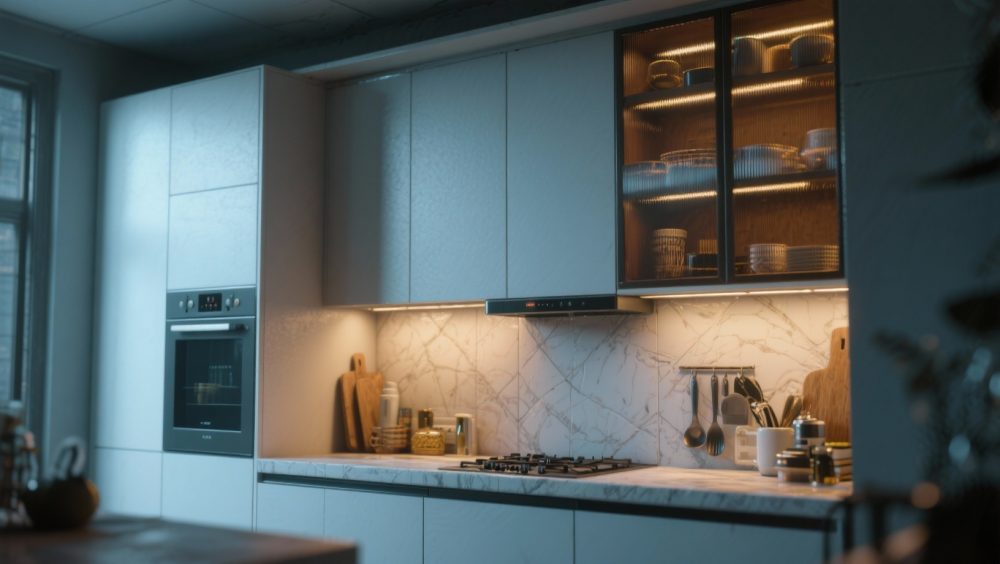 Selecting a countertop with a glossy or semi- gloss finish is among the most efficient yet frequently under-appreciated approaches to artistically expand a little kitchen. More honestly brighten a room because these surfaces reflect sunlight from above lights as well as from windows.
In small kitchens where every surface sets the tone, a shining counter adds dimensionality and depth; hence, bigger layouts are now possible. Sophisticated, reflective sheen offered by granite, quartz, or solid surface tops softly brightens the space without over-saturating it. Though still classy, a semi-gloss finish is ideal for hectic homes as it offers a more fluid shine forgiving of a few smudges and fingerprints.
@ampquartzcabinets Lagi besar islan, lagi banyak storage boleh letak 🤗🤝🏻 #AmpQuartz #islandcabinet #storage #tips #fyp
The reflective surface emphasises the impression of openness and circulation with light or neutral tones, hence altering much more. Because this finish is also flexible enough to go with matte cabinets and vibrant backsplashes, it balances rather than feels difficult. Here consistency is key; ensuring the reflective surface swings regularly across the counter rather than drawing attention with too much texturing or graphic disruptions.
Choosing a polished or semi-gloss countertop finish eventually improves the visual openness of a small kitchen and helps to create a sleek, raised appearance — a quiet but powerful design decision changing restricted space into a bright, welcoming culinary centre.
Custom Countertop Strategies 5: Extend Countertops Into Backsplashes
By extending the counter surface up to create a backsplash, one of the most effective methods to graphically expand a tiny kitchen is. This technique frees tiny kitchens by eliminating visible fractures and grout lines that might give them an enclosed or crowded aspect.
Using the same stone, quartz, or solid-surface material throughout horizontal and vertical planes produces a smooth, flowing surface that lightly guides the eye around the space rather than arresting it at busy intersections. Usually found in affluent houses, the extravagant, bespoke design is given the kitchen by this material consistency, which also improves the impression of openness.
Light to mid-tone surfaces are particularly effective at maximising brightness and reflecting ambient light, so expanding the seen perimeter of the room. Additionally simple to maintain, the larger backsplash shields walls from spills and splashes since there are no mixed materials aging at various rates or grout lines to clean.
For those who love clean, modern design, this approach enables cabinets, lighting, or carefully selected furniture to dominate the room and help to produce a minimalist appearance by lowering visual clutter. Whether your kitchen is minimalist Scandinavian-calm, contemporary, sleek, or classically natural, countertop-to-backsplash continuity offers useful lifespan and a subdued visual lengthening that makes a tiny kitchen seem gracefully open, connected, and appropriately raised.