
Key takeaways
- The resin in quartz is why it needs trivets and is usually kept indoors; sintered stone has no resin.
- Pick sintered stone for heavy wok cooking, a sunny bay window, or an outdoor or BBQ counter.
- Pick quartz for integrated sinks, softer edge profiles, busy family kitchens and a tighter budget.
- Sintered stone is harder but can chip at sharp edges, so edge design and fabricator skill matter more.
- Silica rules in Australia and California target slab fabrication, not finished tops at home; ask for the data sheet either way.

In May 2026, California’s workplace safety standards board voted 3-0 to start writing a rule that would stop workers from cutting and installing artificial stone with more than 1% crystalline silica, Bloomberg Law reported. Australia already banned engineered stone benchtops in July 2024, but its rules specifically exclude sintered stone that contains no resin.
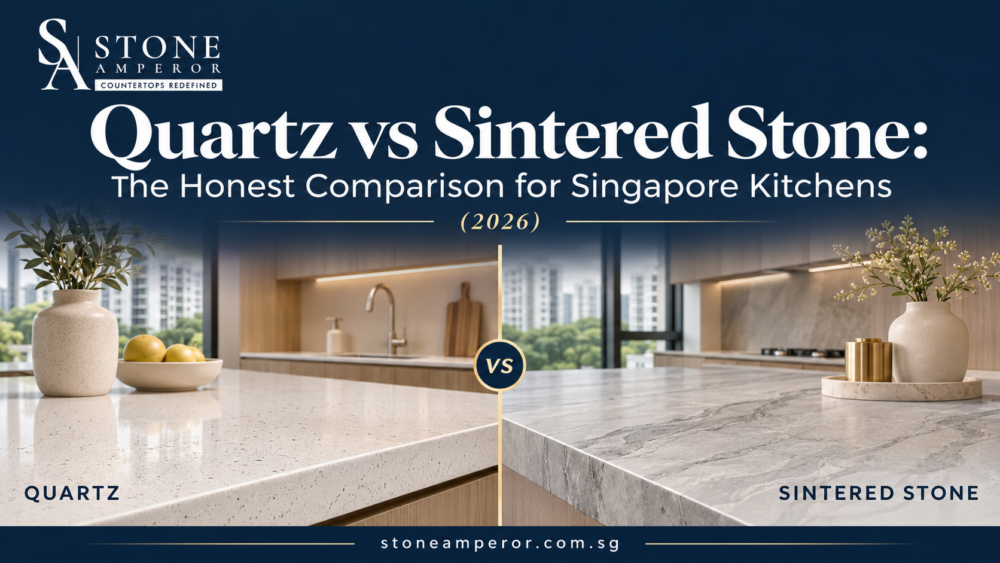
So it’s no surprise that “quartz or sintered stone?” is now one of the first questions Singapore homeowners ask us. Both look premium, both are low maintenance, and showroom staff often describe them the same way. They’re not the same material, though, and the difference shows up years later: near the hob, under the window, and at the edge where the kids bang their bowls.
Here’s the straight comparison we give at Stone Amperor, so you can pick the right one before you pick the colour.
Already torn between two slabs? Send us both names and your kitchen layout. We’ll tell you which one suits how you cook.
What is the difference between quartz and sintered stone?
The difference between quartz and sintered stone is the binder. Quartz is “made from quartz aggregate held together with a resin binder”, according to the US National Institute for Occupational Safety and Health. Sintered stone has no resin: natural minerals are pressed and fired until the particles fuse into one solid slab.
How each slab is made
Simplified. Recipes vary by brand. Press figure from Cosentino.
On the quartz side, brands like Caesarstone and Silestone are the names most Singapore homeowners know. On the sintered side, you’ll mostly meet Dekton and Lapitec. Lapitec describes its slabs as 100% natural minerals, free of resins and petroleum derivatives. If you want the deeper science, we’ve explained how Dekton is made and the different sintered stone techniques in separate guides.
Think of it like kueh versus porcelain. Quartz is like a firm kueh: the ingredients are set with a binder, strong for daily use but not something you leave in the oven. Sintered stone is like a porcelain bowl: fired until it becomes one hard piece, so heat doesn’t bother it. Drop the bowl on its rim, though, and it can chip.
Quartz vs sintered stone, side by side
Quartz and sintered stone are both non-porous, low-maintenance and available in marble looks, so the real decision comes down to heat, sun, edges and budget. Here’s how they compare on the points that matter in a Singapore kitchen.
| Point | Quartz | Sintered stone |
|---|---|---|
| What holds it together | Resin binder | Fused minerals, no resin |
| Hot pots and pans | Use a trivet; resin can scorch | Tolerates hot cookware well Wins |
| Direct sun and outdoor use | Generally indoor only | UV doesn’t fade it; outdoor-rated Wins |
| Stains and daily cleaning | Very low porosity, wipe clean | Very low porosity, wipe clean Tie |
| Scratches | Good; avoid cutting directly on it | Very hard, excellent scratch resistance Wins |
| Knocks at edges and corners | More forgiving Wins | Can chip at sharp edges |
| Pattern through the slab | Colour runs through the body | Depends on brand: some surface-printed, some full-body |
| Thin profiles | Typically thicker slabs | Dekton comes in 12 and 20 mm for tops, down to 4 mm for walls Wins |
| Fabrication and repair | Easier to cut, shape and patch Wins | Needs specialist tools and skill |
| Integrated sinks and edge profiles | Wider choice Wins | More limited |
| Typical cost | Wide range; entry options available Wins | Usually above mid-range quartz |
Looking for a third option? Kompacplus sits in between for slim, modern profiles, and our 2026 countertop handbook compares every material we carry.
Is sintered stone better than quartz for heat and the Singapore sun?
Yes. Heat and sunlight are where sintered stone clearly beats quartz, because there’s no resin to scorch or fade. Caesarstone’s own care manual recommends using a trivet on quartz to prevent the material burning. Cosentino, by contrast, says Dekton is unaffected by ultraviolet rays and certified A1 non-combustible.
That matters more here than in most countries. NEA notes that Singapore’s UV index commonly reaches “Very High” and “Extreme” levels between 11am and 3pm on clear days. A quartz top under a west-facing window or a bay window takes that every afternoon. For a countertop that extends to a balcony, a BBQ pit or a landed home’s outdoor kitchen, sintered stone is the safer pick, full stop.
For wok cooking indoors, it’s closer. Quartz is fine if you rest the wok on a trivet and keep the hot pot off the surface. If your household doesn’t do trivets, or the hob sits close to the edge, choose sintered stone near the hob.
Got a sunny window or outdoor counter? WhatsApp us a photo of the space and we’ll shortlist sintered stone colours that suit it.
Sintered stone disadvantages you should know before buying
Sintered stone’s main disadvantages are edge chipping, harder fabrication and repair, fewer edge and sink options, and a higher price. None of them are deal-breakers, but they’re the things showroom brochures tend to skip.
- Edge chipping. Sintered stone is very hard, and hard materials can be brittle. A heavy pot dropped on a sharp, square edge can take out a chip. An eased or rounded edge helps a lot.
- Surface patterns on some brands. Some sintered slabs carry a printed pattern on the surface rather than through the body. If one chips, the core colour can show. Full-body products such as Lapitec avoid this, so ask which type you’re buying.
- Fabrication skill. Cutting hob and sink openings needs specialist equipment and an experienced team. A rushed cut-out can crack. This is the part of the job to be fussy about.
- Harder to repair. A chip in quartz can often be filled and polished on site. On sintered stone, repairs are possible but less invisible.
- Fewer edge and sink options. Thin sintered slabs suit sharp, modern edges. Ornate profiles and fully integrated sinks are easier in quartz or solid surface.

Where quartz still wins over sintered stone
Quartz still wins for busy family kitchens, integrated sinks, softer edge designs and tighter budgets. Its resin makes it slightly more forgiving when something hits the edge, and its colour runs through the slab, so small chips are less obvious and easier to repair.

Quartz is also simpler to fabricate, which gives you more freedom with mitred edges, waterfall ends and integrated sinks. For a typical indoor HDB or condo kitchen with a dry or semi-wet layout and an induction hob, quartz does the job well and leaves budget for better cabinets. Our quartz pros and cons guide and the quartz brands we supply go deeper.
Sintered stone vs quartz price in Singapore
Sintered stone generally costs more than entry and mid-range quartz once fabrication is included, while premium quartz brands can overlap with it. Both are quoted per foot run in Singapore, fabricated and installed, so the material is only part of the bill.
Three things push sintered stone up: the slab itself, the slower and more careful cutting, and the higher risk on complex cut-outs. Three things push any top up, whichever material you pick:
- Cut-outs and edges. Each hob and sink opening and every special edge adds fabrication work.
- Layout. An L-shape or island may need two slabs and a joint.
- Backsplash and extras. A full-height stone backsplash or a waterfall end adds area quickly.
Our sister site Stone Emperor has detailed buying guides for sintered stone countertops in Singapore and quartz countertops in Singapore. Buying from Johor Bahru? AmpQuartz’s sintered stone vs quartz guide covers the Malaysian side.
Want both prices for your exact kitchen? Send your layout or measurements and we’ll quote quartz and sintered stone side by side.
Quartz, sintered stone and silica: what the new rules mean for you
The silica rules overseas target the workers who cut and polish slabs, not a finished countertop sitting in your kitchen. Silica dust is released during fabrication, which is why both Australia and California are acting on high-silica artificial stone. None of these rules apply in Singapore, but they explain why more homeowners now ask about silica.
Composition is the reason quartz gets the attention. The US Occupational Safety and Health Administration says crystalline silica can make up to 95% of engineered stone, while granite can contain up to 50%. Even with wet cutting, a SafeWork NSW study found that 15 of 27 engineered stone workshops had at least one worker above the exposure limit.
Brands are responding. Cosentino labels its Silestone colours at a maximum of 40% or 10% crystalline silica. In Australia, resin-free sintered stone and porcelain fall outside the engineered stone definition. Whichever slab you choose, ask your supplier for the product data sheet and how the fabricator controls dust.
Quartz or sintered stone? A quick decision guide for your kitchen
Choose sintered stone if heat, sun or outdoor use is part of the picture; choose quartz if you want forgiving edges, integrated sinks or a lower price. Find your situation below.
Outdoor counter or BBQ area
UV doesn’t fade it, and it handles heat from the grill.
Sunny bay or west-facing window
Afternoon sun won’t yellow or dull the surface over time.
Heavy wok cooking, no trivets
Hot woks and pots on the counter are far less of a risk.
Young kids and rough daily use
Softer edges forgive knocks, and small chips are easier to fix.
Integrated sink or curved edges
Easier to shape for seamless sinks and custom profiles.
Tighter budget, indoor kitchen
Great value for dry or semi-wet HDB and condo kitchens.
Some homeowners combine both: sintered stone near the hob or outdoors, quartz on the island where the family eats. If you’re replacing an old top rather than starting fresh, our countertop replacement service keeps your cabinets and swaps only the stone. For new cabinets to go under it, our group’s cabinet maker AmpQuartz builds custom kitchens.
Still not sure? Tell us how you cook and where the counter sits, and we’ll recommend one in a single message. Or browse the brands we carry.
Quartz vs sintered stone: frequently asked questions
Is sintered stone better than quartz?
Sintered stone is better for heat, direct sunlight and outdoor use because it contains no resin. Quartz is better for chip resistance at edges, easier fabrication and repair, integrated sinks and a wider range of edge profiles. Neither is better for every kitchen; the right choice depends on how you cook, how much sun the counter gets and your budget.
What is the difference between quartz and sintered stone?
Quartz (engineered stone) is quartz aggregate held together with a resin binder. Sintered stone is made from natural minerals pressed under very high pressure and fired at high temperature, so the particles fuse without resin. The resin is why quartz needs trivets and is usually kept indoors, while resin-free sintered stone handles heat and UV better.
Is sintered stone more expensive than quartz in Singapore?
Sintered stone generally costs more than entry and mid-range quartz once fabrication is included, because it is harder to cut and finish. Premium quartz brands can overlap with sintered stone prices. Countertops in Singapore are quoted per foot run, so the final price depends on brand, thickness, cut-outs, edges and backsplash.
Can I put a hot pot directly on a quartz countertop?
It is not recommended. Quartz contains resin, and Caesarstone’s care manual recommends using a trivet to prevent the material burning. Sintered stone tolerates hot cookware much better, though a trivet is still good practice for long periods of constant heat.
Does sintered stone chip easily?
Sintered stone is very hard and scratch resistant, but thin slabs can chip at sharp edges and corners if hit by heavy objects. Choosing an eased or rounded edge, a thicker slab for exposed edges, and an experienced fabricator reduces the risk.
Is Dekton a sintered stone?
Yes. Dekton by Cosentino is an ultracompact sintered surface made under very high pressure without resin. Cosentino states that Dekton is unaffected by ultraviolet rays, is certified non-combustible (A1) and is available in 4, 8, 12, 20 and 30 mm thicknesses.
Which is better for an outdoor or BBQ kitchen, quartz or sintered stone?
Sintered stone. Resin-free sintered surfaces such as Dekton and Lapitec are marketed for outdoor use because UV light does not fade them. Standard quartz contains resin and is generally specified for indoor use.
Sources
- Bloomberg Law, “California Board Advances Quartz Countertop Fabrication Ban”, 22 May 2026
- Australian Government, Engineered stone ban: what is and is not banned
- NIOSH (CDC), Outbreak of silicosis among engineered stone countertop workers
- OSHA, Silica hazard alert: engineered stone
- Weller et al. (SafeWork NSW), Annals of Work Exposures and Health, 2024
- Cosentino, Dekton
- Cosentino, Silestone
- Indesign Live Singapore, Lapitec sintered stone applications, March 2023
- Caesarstone, Care and maintenance manual
- National Environment Agency, UV radiation and UV index