- By: Ryo
- Tags: Countertop Design Mistakes, countertop errors, countertop mistakes, kitchen countertop issues, small kitchen countertops
- Category: Countertop Design Mistakes
- 0 comment
Countertop design mistakes in your small HDB kitchen might rapidly go from a welcoming cooking area to a daily source of frustration. Bad material selections, clumsy arrangements, or misaligned elevations can make even basic chores appear heavy. Avoiding these mistakes guarantees that your countertop improves the harmony and usefulness of your small kitchen.
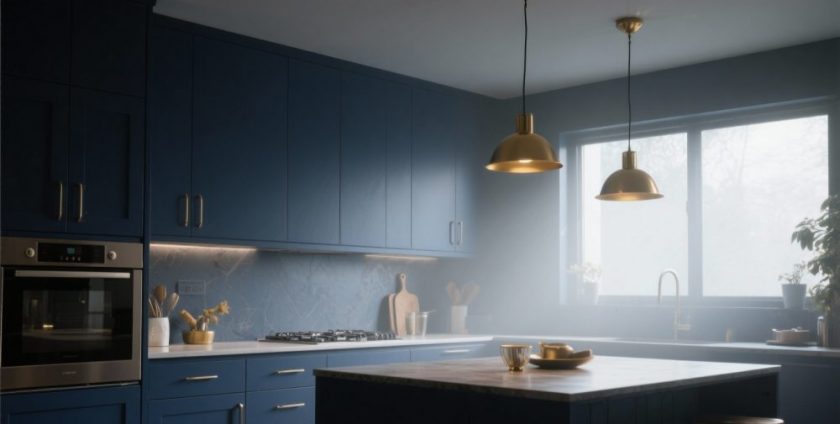
Countertop Design Mistakes 1: Choosing Dark or Busy Countertop Patterns
Choosing dark or busy countertop patterns is among the most often made design mistakes; this might fast render a little HDB kitchen seem messy and tiny. Although deep colours and evident veins appear beautiful at first, they absorb rather than reflect light, therefore producing a heavy, enclosed environment.
Visual openness is essential in little kitchens where every square foot counts; darker counters may actually contract your work surface. Designs saturated with strong veining or speckles may also overload the eye and cause the room to appear busy despite its neatness. Rather than trying to draw notice, a counter should enhance silent operation.
Choosing more vivid colours like off-white, white, or light grey helps to bounce room lighting and therefore create the appearance of space and purity. A room can be given character without dominating it by delicate textures or fine-grain designs. Matching them with sophisticated cabinets and sufficient task lights enhances both equilibrium and clarity.
Selecting the incorrect surface can unintentionally create a stress zone rather than a pleasant kitchen; residents often underestimate how much colour and design influence perception and attitude. View your counter top as more than just a useful element but also as a visual anchor that determines the mood of your kitchen to maximise your HDB kitchen. Selecting more muted, more elegant designs will enable you to change a limited space into a harmonic, stress-free setting that seems more airy, tidy, and entertaining to use daily.
Countertop Design Mistakes 2: Using High-Maintenance Materials
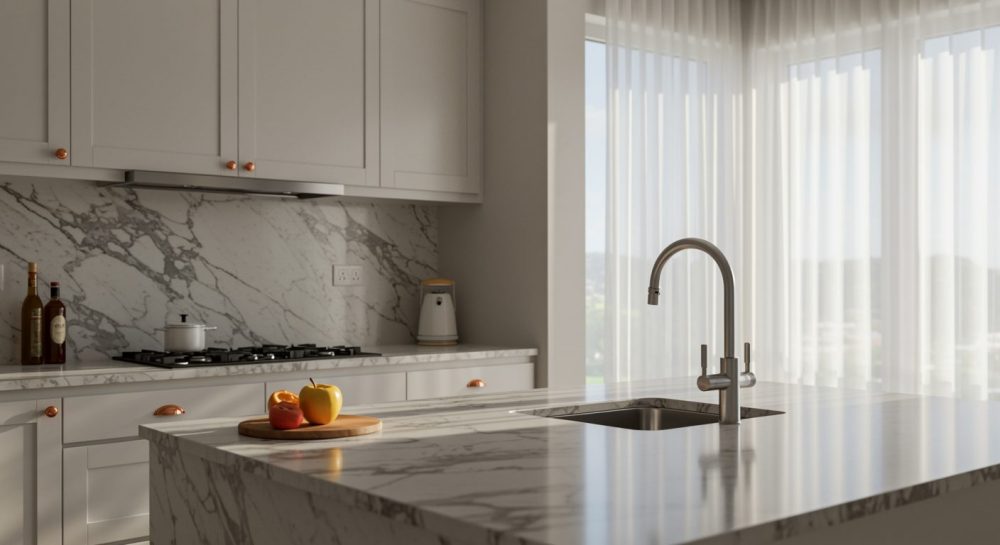 Using high-maintenance materials is one of the worst counter design errors that might change your tiny HDB kitchen into a daily stress zone. Although magnificent in showrooms, luxurious choices like marble or natural stone need continual maintenance that is not compatible with most homeowners’ quick life.
Porous materials can swiftly turn into a source of aggravation in tiny kitchens with constant use on every surface. Over time, marble for example absorbs spills from oils, sauces, or coffee readily, resulting in difficult stains and lifeless spots. Natural stones, too, might need regular sealing to preserve their initial finish, thereby increasing your maintenance responsibility.
@ampquartzcabinets Yang tanya kenapa laminate ABS colour tak sama? Boleh tengok video ni! 😘 #AmpQuartz #SolidPlywood #LaminateABS #fyp
In a tiny HDB kitchen, where space is already limited, the last thing you need is a countertop that needs regular polishing or protection from everyday cooking events. Choosing low-maintenance materials like quartz or Silestone will instead greatly minimise maintenance while keeping a sophisticated look. These designed surfaces are stain-resistant, non-porous, and tough — ideal for small urban kitchens seeking design as well as practicality.
They provide a large selection of colours and finishes beyond their long life that simulate natural stone without the bother. Selecting a substance that blends elegance with simplicity of upkeep lets your countertop remain sleek and spotless with very little effort. Avoiding high-maintenance materials finally not just saves time but also helps you design a stress-free, effective kitchen that really improves your daily quality of life.
Countertop Design Mistakes 3: Ignoring Proper Countertop Height and Depth
One of the most under appreciated but effective countertop design errors that may rapidly transform a little HDB kitchen into a daily stress area is ignoring proper countertop height and depth. Many homeowners concentrate on hue and material but ignore that comfort and practicality begin with the proper measurements.
While a countertop that is too low can result in back strain from continuous bending, one that is too high makes food preparation exhausting and difficult. Likewise, lack of depth restricts your workspace, thereby minimising space for appliances or cutting stations; on the other hand, too great depth makes reaching the rear challenging. of the counter, especially in small designs.
For most consumers, the perfect countertop height often falls between 85 and 90 centimetres, therefore striking ergonomic comfort. HDB kitchens benefit from depths of roughly 60 centimetres, which provide enough cooking space without dominating the room. Ignoring these aspects interrupts workflow and frustrates meal preparation or housekeeping. Furthermore, visual asymmetry and inefficiency may result from incorrect alignment between the countertop and surrounding features like sinks or cooktops.
Every centimetre counts in tiny kitchens; the secret is to design carefully and intentionally. Consulting with experts or utilising flexible counter solutions might assist. Modify the arrangement to match your height and lifestyle. In the end, the perfect depth and height for your countertop convert your kitchen into a practical, stress-free area that promotes simple movement and pleasant cooking everyday, not just comfort.
Countertop Design Mistakes 4: Neglecting Lighting Above the Countertop
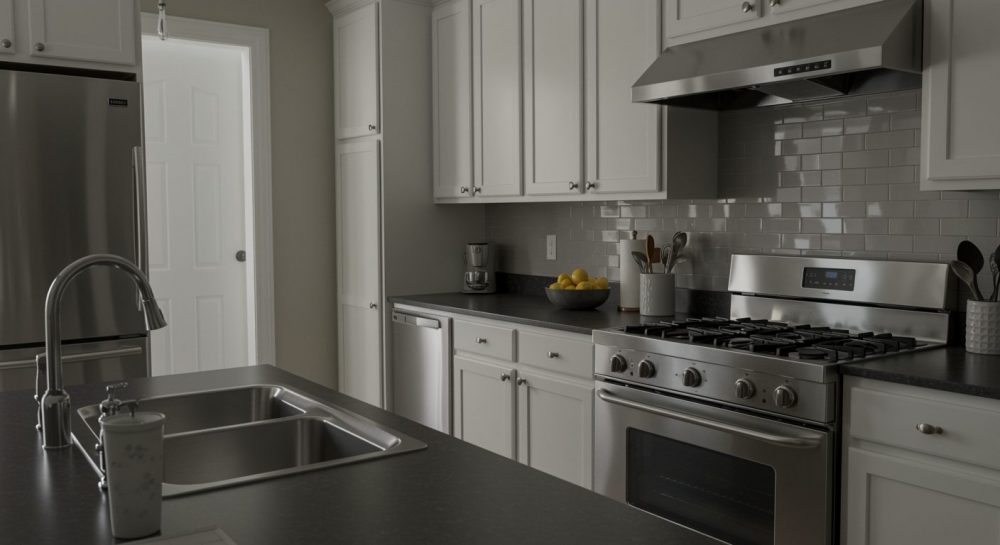
Disregarding the lighting above it is one of the most disregarded countertop design mistakes that may rapidly turn your little HDB kitchen into a hectic, inefficient space. Bad lighting could make food preparation challenging and even with great materials and a well-thought-out layout, the whole kitchen look tight and gloomy.
In small HDB homes where natural light is often limited, counters serve as the principal workstation for cooking, chopping, and food plating — tasks need sharp, concentrated lighting. Relying solely on ceiling lights or a solitary source of ambient light creates shadows hiding your desk and increases the possibility of incidents, therefore giving the space visual heft. If they lack enough task illumination, even hip counters lose their aesthetic appeal and appear boring and unwelcome.
@ampquartzcabinets Nak dapur sama macam Pinterest pun kita boleh buat tau 🥰🫶🏻 #AmpQuartz #KitchenCabinet #Pinterest #dapuridaman #fyp
To avoid this, adding tiered lighting is essential. Under-cabinet LED strips or recessed lights may brighten dark areas, draw attention to the surface of the counter, and increase visibility while food preparation is being done. Warm-toned lighting might also give the room a friendlier feel and improve the texture and colour of the countertop. Moreover, by enhancing its size, properly positioned lights may give a small kitchen more openness and sophistication.
Not only does ignoring this element hamper performance but also adds unneeded stress to daily cooking habits. Adding will enable you to convert your little HDB kitchen from a dim, frustrating space into one with a light, effective, well-balanced counter lighting making it politely welcome — showing that basic design is efficient lighting rather than just decoration.
Countertop Design Mistakes 5: Failing to Integrate Countertop with Overall Layout
Failing to match the counter with the whole layout is among the most costly errors in counter design that can turn your little HDB kitchen into a stressful area. Every inch counts in tight areas, thus a poorly coordinated countertop can obstruct the appearance and movement of the kitchen.
For example, it produces odd gaps or blocked walkways that make cooking and cleaning annoying if the countertop doesn’t sit exactly with cabinetry or appliances. Additionally, a mismatched design can result in ineffective processes, thereby making you to move back and forward needlessly between the sink, stovetop, and prep area. Beyond utility, mismatched countertop materials, thickness, or hues may visually break up the kitchen, hence making it seem smaller and untidy.
The secret is careful planning; making sure the countertop goes with the cabinetry style, fits in with built-in appliances, and has enough room for daily tasks. Including elements like integrated sinks or extended breakfast bars can improve both beauty and utility without over-saturating the room. Moreover, thinking about how light interacts with the countertop especially in open-plan designs can assist you keep visual balance throughout your kitchen.
Homeowners can turn their little HDB kitchens into effective, integrated part of the entire design rather than an afterthought, harmonised, soothing areas. Integration not only improves the general visual appeal but also guarantees that the kitchen operates effectively, hence lowering daily stress and maximising every square foot.

