
- By: Ryo
- Tags: Countertop Edge Styles, countertop style, Kitchen Countertop, kitchen countertop type
- Category: Countertop Edge Styles
- 0 comment
With countertop edge styles, small kitchens can be profoundly affected in their appearance. Rounded edges like the whole bullnose help to maximise countertop usage while fostering a gentler, safer surroundings. Sleek square or beveled edges provide a contemporary, streamlined look without dominating small kitchen designs.
Countertop Edge Styles 1: Eased
Among the most popular countertop edge designs for little kitchens, the eased edge stands out for its balance of simplicity, safety, and adaptability. An eased edge is essentially a straight edge with slightly rounded corners, giving countertops a modern, streamlined appearance without seeming too sharp or harsh.
This understated design works miracles in tiny kitchens where every aspect influences the perception of space by producing smooth visual lines that help the room seem more open and tidy. From a functional perspective, the softened edge is both safe and helpful. Particularly crucial in tiny kitchens where movement is constant, the rounded edges lower the chance of unintentional bumps or scratches. Because there are no deep grooves or complex designs that can trap dust and crumbs, keeping it is also simpler than with more decorative edge designs.
Another benefit is cost-effectiveness; although providing a polished, upscale appearance, eased edges are among the most affordable choices. Homeowners who value adaptability would also appreciate how this edge goes well with nearly any design style, from traditional to modern, and easily integrates with a range of fabrics. of materials including quartz, granite, or solid surface countertops.
The eased edge provides a sleek, durable, and classic solution for tiny kitchens that need both utility and visual harmony that improves the general flow. of the room while maximising usability. Its subtle elegance makes it a design favourite for producing aesthetically appealing and really efficient kitchens.
Countertop Edge Styles 2: Beveled Edge
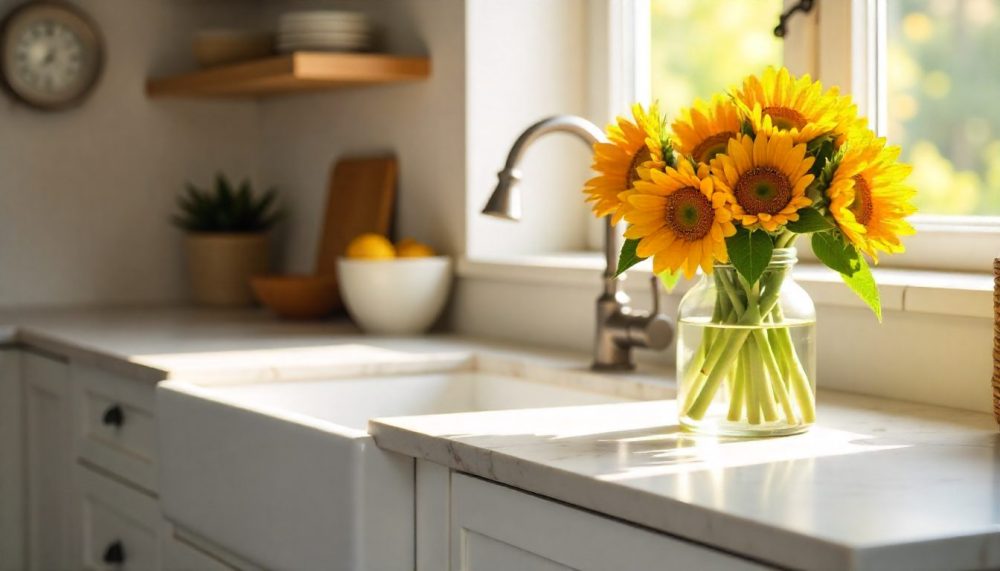 One of the most flexible and fashionable counter edge designs is a beveled edge, therefore it’s a great pick for little kitchens when beauty and hand in hand should be functionality. With its delicate 45-degree angle cut over the top edge, the beveled profile immediately adds depth and dimension without overpowering the little area.
This angled element catches light wonderfully in tiny kitchens where clean lines and visual flow are essential, giving both modern and transitional interiors a sophisticated look. The beveled edge has functional advantages: it is simpler to clean than more elaborate profiles like ogee, and crumbs or spills do not become trapped in deep grooves.
@ampquartzcabinets Buat kabinet dengan kami boleh dapat PERCUMA 4 JAM CLEANING SERVICE ✅ 🥳 #AmpQuartz #CabinetMaker #JohorBahru #cleaningservice #fyp
Its slanted surface also aids in lessening the visibility of wear on the very top edge, hence helping the countertop seem sharp for longer. The beveled edge hits the sweet equilibrium for homeowners who want something more unique than a basic eased or square edge yet less cumbersome than a full bullnose. It gives personality and sophistication while being simple to clean and maintain — a must in smaller areas where every design element must earn its position.
Available in single or double bevel versions, it lets one personalise the kitchen’s general atmosphere: a sharper bevel feels modern, whereas a more gentle one leans conventional. For little kitchens, the beveled edge is the best option since it blends timeless elegance with utility to produce a sleek, space-enhancing finish.
Countertop Edge Styles 3: Minimalist Square
The straight edge, sometimes known as the Minimalist Square edge, is among the most sought after solutions for small kitchens due to its modern, elegant appearance and space-enhancing qualities. Particularly effective in small spaces where every component affects the openness, this edge design has crisp, straight lines that give a clean look.
The square edge allows the substance itself — quartz, granite, or solid surface to stand out unlike complex or strongly arched profiles. From a functionality standpoint, the straight edge is easy to keep clean as it has no deep grooves or difficult curves that may trap trash. Or bits so fast and simple daily cleaning is. Modern, durable countertop materials like quartz greatly reduce this danger, hence ensuring long-lasting performance even in hectic kitchens even if its crisp shape might prompt questions on chipping.
Ideal for homes with children or high-traffic areas, the softened square provides a delicate variant of this edge that softly rounds the corners for improved safety without giving the streamlined appearance of the plane away. Furthermore, its versatility complements almost every design scheme from ultramodern flats to modest Scandinavian inspired homes perfectly fusing with light and dark cabinet.
By not drawing attention unneeded, the minimalist square edge makes modest kitchens look larger and more unified. It helps to create visual continuity. For homeowners looking for a mix of elegance, practicality, and classic design, the Minimalist square edge is a fantastic choice as it makes best use of space.
Countertop Edge Styles 4: Decorative Edges
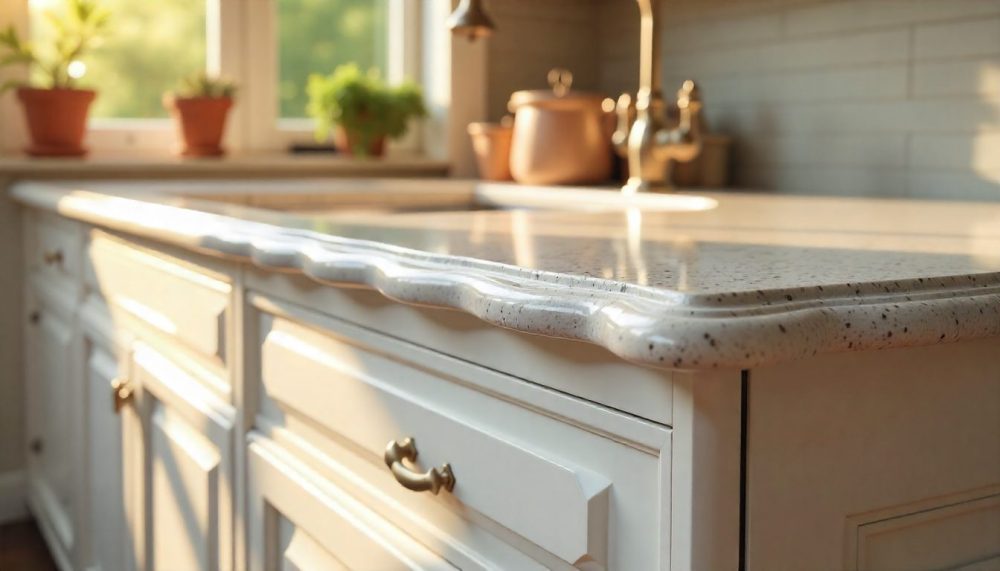 Although a kitchen can benefit from the sophistication and character of ornamental countertop edges like ogee, double ogee, or waterfall profiles, in the Small kitchens’ context calls for careful consideration. By turning the counter like a prominent feature, these elaborate patterns add elegance and depth and immediately improve the appearance of a small area.
Decorative edges can turn a simple surface into a design highlight for homeowners who want their little kitchen to have a luxurious flair. But because these edges are more elaborate and evident, they can sometimes overwhelm the proportions of a little kitchen and give the space a busier appearance than it actually is. Another consideration to consider is functionality; complex grooves tend to gather crumbs and spills more easily than simpler edge profiles, hence needing more maintenance to keep their polished appearance.
@ampquartzcabinets Buat kabinet dengan kami boleh dapat PERCUMA 4 JAM CLEANING SERVICE ✅ 🥳 #AmpQuartz #CabinetMaker #JohorBahru #cleaningservice #fyp
Decorative edges may slightly decrease useful counter area because of their more noticeable curves, therefore making sense in smaller arrangements. Many designers thus suggest using decorative edges sparingly, like on a kitchen island, breakfast bar, or a statement portion of the counter. While keeping the other surfaces in more streamlined forms such eases or half bullnose.
This provides elegance and practicality without dominating the size of the kitchen. In the final analysis, decorative edges in little kitchens look best as accent features, letting homeowners appreciate their classic charm while still giving functionality and space efficiency top priority in daily use.
Countertop Edge Styles 5: Full Bullnose
Among the most adaptable and useful countertop edge designs, the full bullnose edge is a strong contender for little kitchens where both Above all else is aesthetics and safety. Defined by its completely curved shape from top to bottom, the full bullnose softens the appearance of countertops and gets rid of sharp edges that can feel harsh in small spaces.
Since the lack of borders lowers the chance of collisions and other hazards, this makes it particularly helpful in kitchens with narrow aisles or little walking area. injuries give families with elderly members or children a benefit. Apart from safety, the curvature of the full bullnose offers a smooth, continuous flow that visibly lightens countertops, therefore preventing them from appearing hefty in restricted quarters.
Less prone to chipping than sharper edge designs, its rounded form means more long-run resilience. Regular cleaning solves this small disadvantage even if liquids can run off more readily than with more flat edges. From a design point of view, the bullnose matches a great spectrum of tastes, from classic to transitional, giving a classic appearance that does not dominate the visual harmony of the little kitchen.
Its soft curves complement engineered quartz as well as natural stone to improve the material’s gloss and gloss. The entire bullnose is, then, an edge shape that combines safety, durability, and elegance — proof that functionality and design may harmoniously cohabitate even in the tiniest kitchens.

